
7.5 KiB
title, date, weight, cascade
| title | date | weight | cascade | ||
|---|---|---|---|---|---|
| My First Lab | 2025-02-14T12:00:00+02:00 | 1 |
|
Introduction 📚
In this article, we’ll explore how to install our very first Containerlab netlab using DevPod. We'll focus on leveraging a cloud provider—specifically AWS—to host our project. Why Cloud? Because network labs can consume a huge amount of resources, and we need the ability to deploy, stop, and destroy them quickly for both performance and financial efficiency. 💡💰
We'll achieve this using a combination of:
- DevPod
- DevContainer
- Containerlab
Additionally, we will use a small topology, which you can find on my GitHub repository. Our main objective is to deploy this lab on AWS using DevPod. Let's dive in and get started! 🚀😊
Prerequisites 🔧
Before we get started, there are a couple of important steps to complete:
-
AWS Environment Authorization:
Ensure that DevPod is authorized to access your AWS environment. For a detailed guide on configuring DevPod with AWS, please refer to my post on this topic. 🔑 -
Containerlab Topology:
We need a topology file that Containerlab can understand. In our case, we're building a simple VXLAN topology. 🗺️
Containerlab Topology 🔄
Our lab will simulate a VXLAN topology with:
- 1 Spine switch
- 2 Leaf switches
- 2 Host nodes
The following diagram illustrates the VXLAN topology:

Below is the Containerlab topology file (lab_vxlan.yml) used for this setup:
name: vxlan-evpn-irb
topology:
  nodes:
    spine1:
      kind: ceos
      image: ceos:4.32.0.1F
      mgmt-ipv4: 172.20.20.101
    leaf1:
      kind: ceos
      image: ceos:4.32.0.1F
      mgmt-ipv4: 172.20.20.11
    leaf2:
      kind: ceos
      image: ceos:4.32.0.1F
      mgmt-ipv4: 172.20.20.12
    host1:
      kind: linux
      image: alpine:latest
      binds:
        - hosts/h1_interfaces:/etc/network/interfaces
      mgmt-ipv4: 172.20.20.21
    host2:
      kind: linux
      image: alpine:latest
      binds:
        - hosts/h2_interfaces:/etc/network/interfaces
      mgmt-ipv4: 172.20.20.22
  links:
    - endpoints: ["spine1:eth1", "leaf1:eth1"]
    - endpoints: ["spine1:eth2", "leaf2:eth1"]
    - endpoints: ["leaf1:eth2", "host1:eth1"]
    - endpoints: ["leaf2:eth2", "host2:eth1"]
Breaking Down the Topology 🧐
-
Name and Structure:
name: vxlan-evpn-irb– This is the lab's name.- The topology is divided into nodes (devices) and links (connections between devices).
-
Nodes:
- Spine Layer:
spine1: A containerized Arista cEOS switch using image version4.32.0.1F.- Management IP:
172.20.20.101
- Leaf Layer:
leaf1andleaf2: Arista cEOS switches with the same image version.- Management IPs:
172.20.20.11and172.20.20.12
- Host Layer:
host1andhost2: Linux containers running Alpine Linux.- They include custom network interface configurations mounted from the host.
- Management IPs:
172.20.20.21and172.20.20.22
- Spine Layer:
-
Links:
- Spine to Leaf:
spine1:eth1↔leaf1:eth1spine1:eth2↔leaf2:eth1
- Leaf to Host:
leaf1:eth2↔host1:eth1leaf2:eth2↔host2:eth1
- Spine to Leaf:
This topology represents a typical spine-leaf architecture, common in data center networks to enable both Layer 2 and Layer 3 connectivity with VXLAN EVPN configurations. 🔗💻
Deploy the Lab 🛠️
We will deploy the lab using DevPod in two ways:
1. Using the Repository 📥
-
Validate AWS Provider Configuration:
Ensure that your AWS provider is correctly configured. More details can be found here. ✅ -
Create a Workspace:
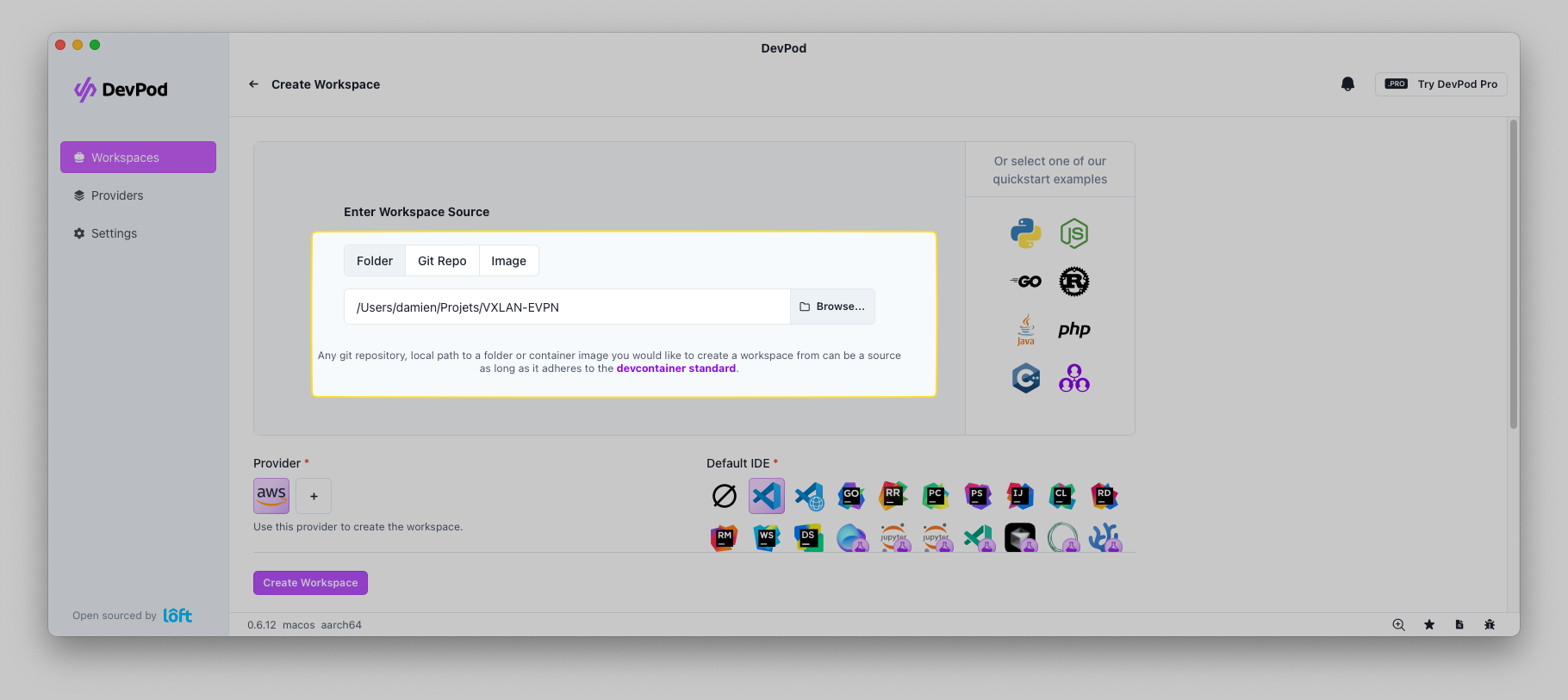
- Navigate to the Workspace tab and click on Create Workspace.
- Enter the Workspace source: use the GitHub repository.
- Select AWS as the provider.
- Choose your default IDE.
- Finally, click on Create Workspace.


2. Using a Local Folder 🗂️
If you prefer to use your local repository:
-
The only difference is in the Workspace source.
-
Simply point it to your local repository.

Starting the Lab 🎬
[!WARNING] cEOS Images The lab uses cEOS image v4.32.0.1F.
To download this image, visit the Arista download webpage. ⚠️
-
Import the cEOS Image:
Save the cEOS image in yournetwork_imagesfolder by dragging and dropping it into VSCode.
Import the image using the following command:docker import network_images/cEOS64-lab-4.32.0.1F.tar.xz ceos:4.32.0.1F -
Deploy the Lab:
Deploy the lab using Containerlab:sudo containerlab deploy -t lab_vxlan.ymlFollow the CLI prompts to configure your devices. For detailed configuration steps, refer to this guide. 🔧🖥️
-
Visualize the Architecture:
Validate the deployed topology using Containerlab’s graph view:containerlab graph -t lab_vxlan.ymlPorts (e.g., port 50080 as mentioned in the
devcontainer.json) are forwarded. Access the graph view via localhost.

Using EdgeShark 🦈
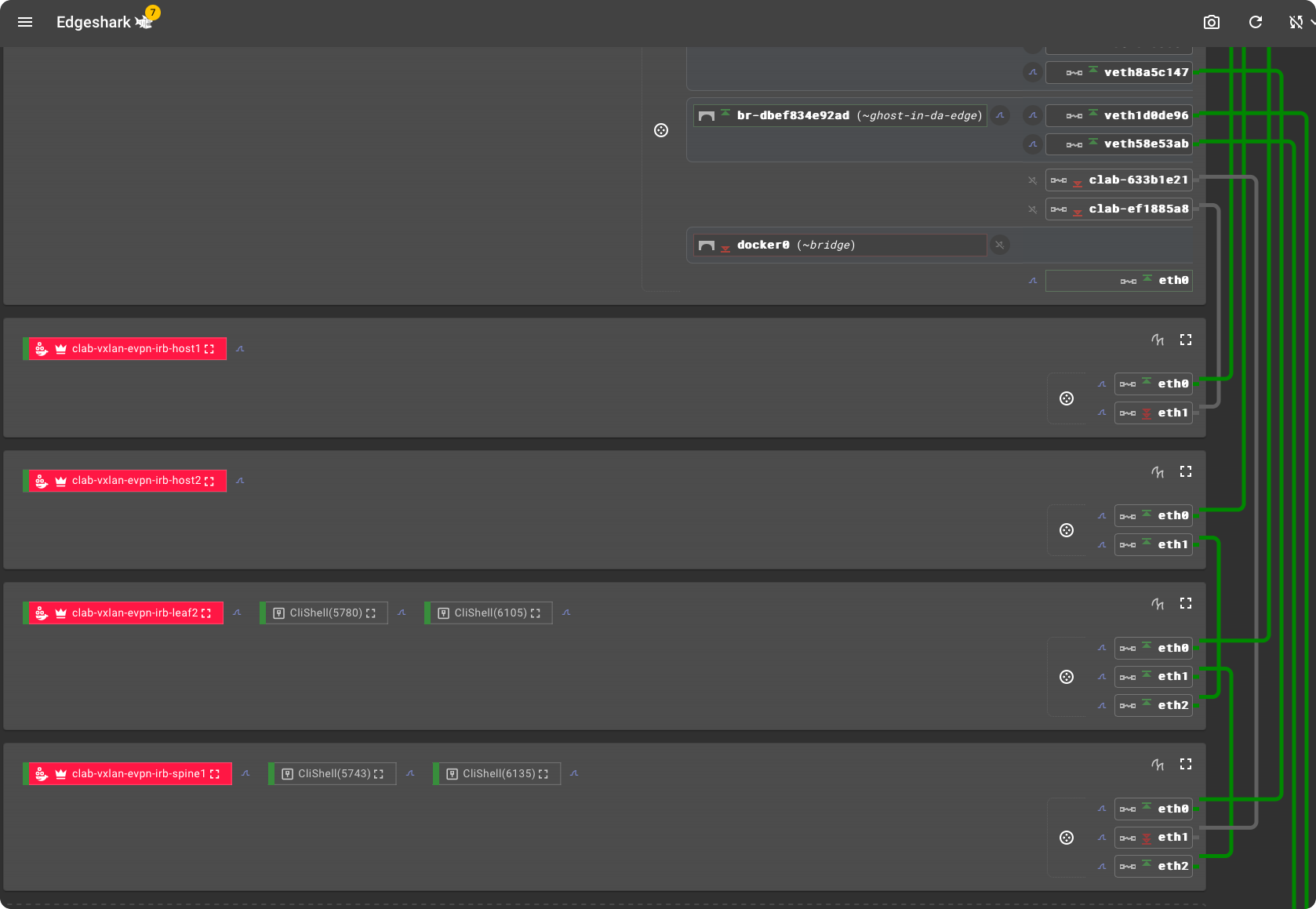
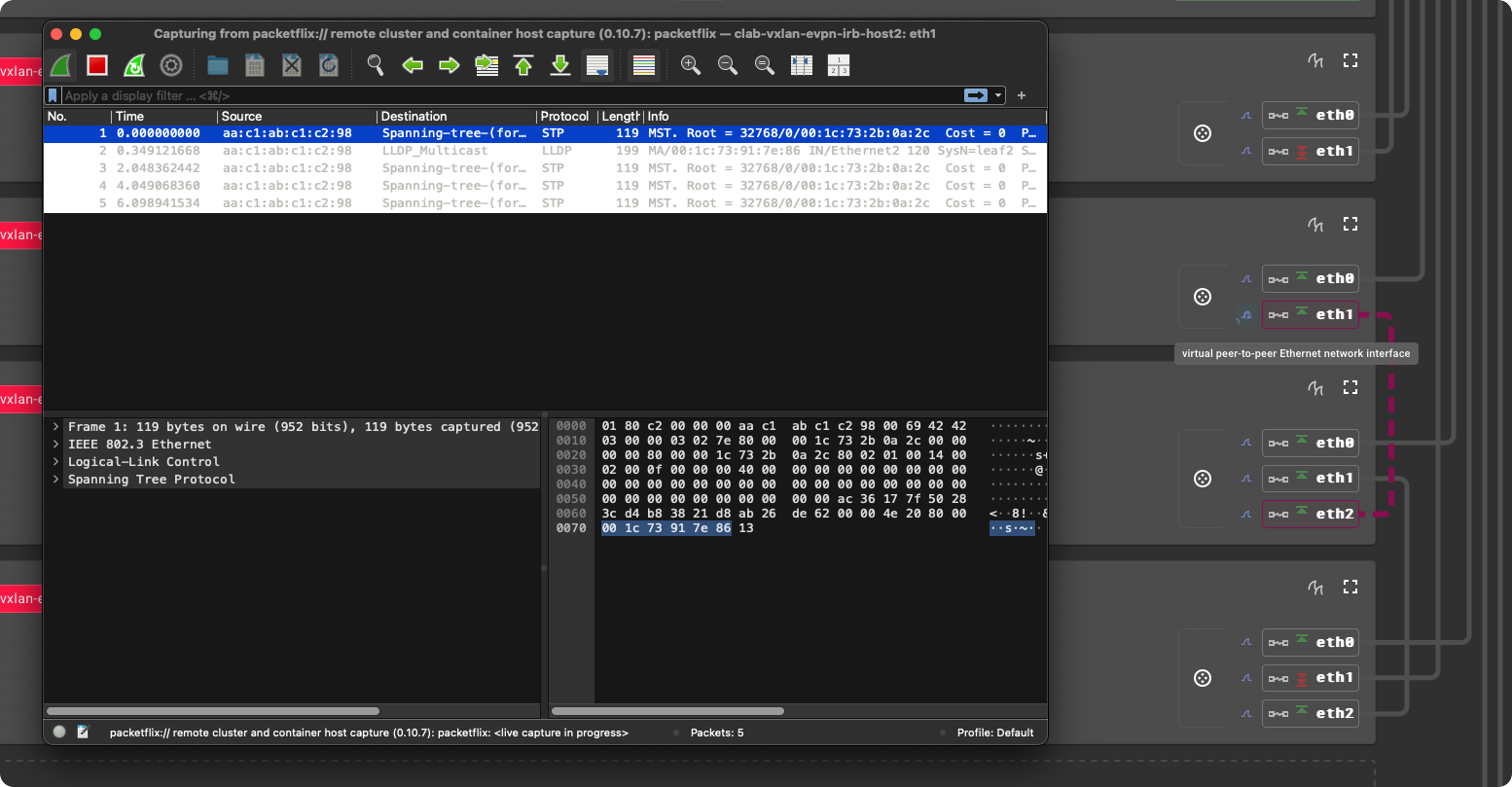
EdgeShark is a web UI tool that helps capture packets from your lab environment. It tunnels captures from the lab to Wireshark running locally. 📡🔍
For more details, check out EdgeShark’s Getting Started Guide.
EdgeShark Setup in the DevContainer 🐳
In the DevContainer configuration, the following postCreateCommand has been added:
sudo mkdir -p /opt/edgeshark && sudo curl -sL https://github.com/siemens/edgeshark/raw/main/deployments/wget/docker-compose.yaml -o /opt/edgeshark/docker-compose.yaml
This command downloads a Docker Compose file to facilitate the use of EdgeShark. 🚀
Running EdgeShark ⚡
To start EdgeShark, execute:
cd /opt/edgeshark
DOCKER_DEFAULT_PLATFORM= docker compose up -d
Access EdgeShark via localhost:5001.
-
EdgeShark View:
-
Wireshark Integration:
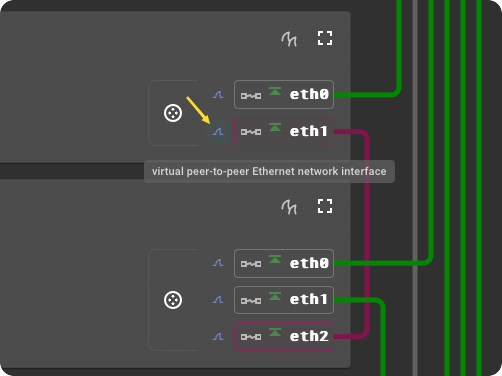
Using the Wireshark icon in EdgeShark, you can launch Wireshark locally.


Conclusion 🎉
In this article, we walked through the steps to deploy a VXLAN EVPN lab using Containerlab, DevPod, and AWS. We covered the following key points:
- Setting up prerequisites for AWS and Containerlab. 🔑
- Creating a detailed topology file for a spine-leaf network. 🗺️
- Deploying the lab using both repository and local methods. 📥🗂️
- Starting the lab with Docker and Containerlab. 🚀🐳
- Using EdgeShark to capture packets and integrate with Wireshark for detailed analysis. 🦈🔍
By following these steps, you can easily deploy and manage a scalable network lab environment in the cloud. Happy networking and enjoy your lab adventures! 😄🎊