Arista EVPN-VXLAN ContainerLab — DC + Core + Campus
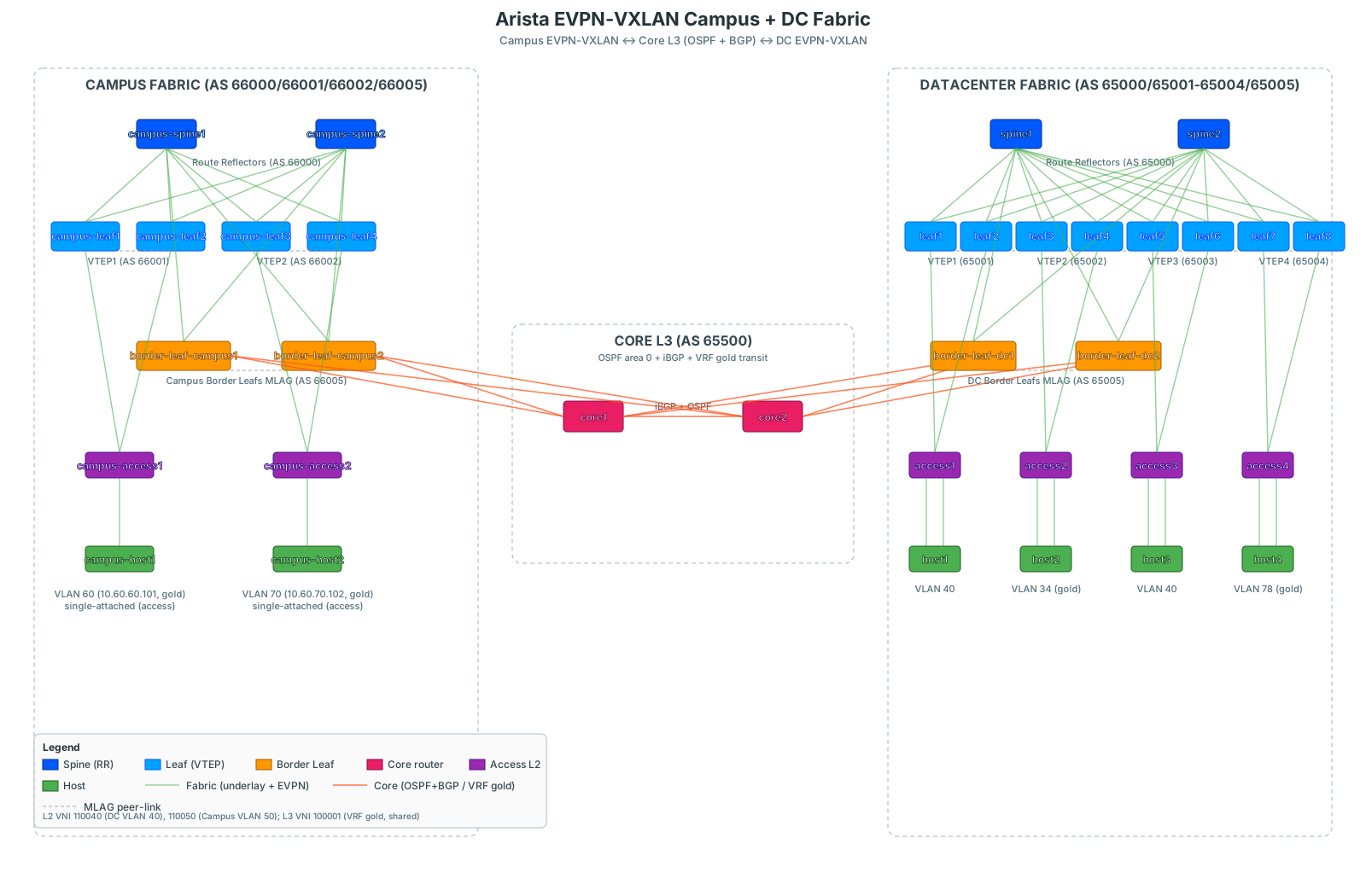
An extended Arista BGP EVPN-VXLAN multi-fabric lab using ContainerLab and cEOS. The topology interconnects a Data Center fabric and a Campus fabric through a dedicated Core L3 transit zone, with a VRF (gold) stretched end-to-end across both fabrics.
🎯 Overview
| Zone |
Devices |
| DC |
2 spines, 8 leafs (4 MLAG VTEPs), 2 border leafs (MLAG), 4 access switches, 4 hosts |
| Core |
2 core routers (iBGP AS 65500, OSPF underlay with BLs, eBGP to DC & Campus BLs) |
| Campus |
2 spines, 4 leafs (2 MLAG VTEPs), 2 border leafs (MLAG), 2 access switches, 2 hosts |
Key design choices:
- eBGP in both fabrics (underlay + EVPN overlay) between spines and leafs / border leafs.
- OSPF area 0 + eBGP multi-hop between each Border Leaf pair and both Core routers (over dot1q subinterfaces:
.100 = default VRF underlay, .200 = VRF gold).
- MLAG everywhere there is dual-homing at the fabric layers (leaf pairs, border-leaf pairs, access → leafs, and DC host → access).
- Host attachment pattern:
- DC hosts (servers) are dual-homed via LACP to an access switch — typical DC
server redundancy.
- Campus hosts (user endpoints: PC, phone, printer) are single-attached to a
Campus access switch via one plain Ethernet link. Redundancy lives at the access-switch
layer (the access switch itself is dual-homed via LACP to its leaf MLAG pair), not at
the host.
- VRF
gold is stretched end-to-end: DC leafs (VLAN 34 / 78) ↔ DC-BL ↔ Core ↔ Campus-BL ↔ Campus leafs (VLAN 60 / 70), all sharing L3 VNI 100001.
- VLAN 50 remains defined as a campus-local L2 VXLAN stretched between the two Campus VTEPs (infrastructure-only, not wired to any host in the current topology).
- Convention: L2 VNI =
110000 + vlan_id, L3 VNI = 100001 for VRF gold, RT 1:100001 in both fabrics.
📐 Topology
🚀 Quick Start
Prerequisites
- ContainerLab
- Docker
- Arista cEOS image:
ceos:4.35.0
Deploy the Lab
Access Devices
📋 Architecture
Node Inventory
| Zone |
Role |
Nodes |
AS |
| DC |
Spine |
spine1, spine2 |
65000 |
| DC |
Leaf VTEP1 (MLAG) |
leaf1, leaf2 |
65001 |
| DC |
Leaf VTEP2 (MLAG) |
leaf3, leaf4 |
65002 |
| DC |
Leaf VTEP3 (MLAG) |
leaf5, leaf6 |
65003 |
| DC |
Leaf VTEP4 (MLAG) |
leaf7, leaf8 |
65004 |
| DC |
Border Leaf (MLAG) |
border-leaf-dc1, border-leaf-dc2 |
65005 |
| DC |
Access (L2-only) |
access1-access4 |
— |
| DC |
Host |
host1-host4 |
— |
| Core |
Core router |
core1, core2 |
65500 |
| Campus |
Spine |
campus-spine1, campus-spine2 |
66000 |
| Campus |
Leaf VTEP1 (MLAG) |
campus-leaf1, campus-leaf2 |
66001 |
| Campus |
Leaf VTEP2 (MLAG) |
campus-leaf3, campus-leaf4 |
66002 |
| Campus |
Border Leaf (MLAG) |
border-leaf-campus1, border-leaf-campus2 |
66005 |
| Campus |
Access (L2-only) |
campus-access1, campus-access2 |
— |
| Campus |
Host |
campus-host1, campus-host2 |
— |
AS Numbering
| AS |
Role |
| 65000 |
DC Spine |
| 65001 |
DC VTEP1 (leaf1/2) |
| 65002 |
DC VTEP2 (leaf3/4) |
| 65003 |
DC VTEP3 (leaf5/6) |
| 65004 |
DC VTEP4 (leaf7/8) |
| 65005 |
DC Border Leaf pair |
| 65500 |
Core (iBGP between core1 & core2) |
| 66000 |
Campus Spine |
| 66001 |
Campus VTEP1 (campus-leaf1/2) |
| 66002 |
Campus VTEP2 (campus-leaf3/4) |
| 66005 |
Campus Border Leaf pair |
Access Switches
| Access Switch |
Uplink Pair |
VLANs |
Host |
Host attachment |
| access1 |
leaf1/2 (VTEP1) |
40 |
host1 |
LACP Po1 (dual-homed) |
| access2 |
leaf3/4 (VTEP2) |
34 |
host2 |
LACP Po1 (dual-homed) |
| access3 |
leaf5/6 (VTEP3) |
40 |
host3 |
LACP Po1 (dual-homed) |
| access4 |
leaf7/8 (VTEP4) |
78 |
host4 |
LACP Po1 (dual-homed) |
| campus-access1 |
campus-leaf1/2 (VTEP1) |
60 |
campus-host1 |
access port (single link) |
| campus-access2 |
campus-leaf3/4 (VTEP2) |
70 |
campus-host2 |
access port (single link) |
All access switches are L2-only, LACP-bonded to their leaf MLAG pair via Port-Channel10. MSTP + edge-port BPDU guard.
Host-facing ports:
- DC access switches run a
Port-Channel1 trunk (VLANs allowed per host) for a host
dual-homed in LACP (two physical links, one bond on the Linux side).
- Campus access switches use a plain
Ethernet3 in switchport mode access with
BPDU guard + portfast — the host connects with a single Ethernet link and no bonding.
🧭 IP Addressing Plan
Management (172.16.0.0/24)
| Node |
IP |
Node |
IP |
| spine1 |
172.16.0.1 |
campus-spine1 |
172.16.0.20 |
| spine2 |
172.16.0.2 |
campus-spine2 |
172.16.0.21 |
| border-leaf-dc1 |
172.16.0.3 |
border-leaf-campus1 |
172.16.0.22 |
| border-leaf-dc2 |
172.16.0.4 |
border-leaf-campus2 |
172.16.0.23 |
| core1 |
172.16.0.10 |
campus-leaf1-4 |
172.16.0.51-54 |
| core2 |
172.16.0.11 |
campus-access1 |
172.16.0.61 |
| leaf1 |
172.16.0.25 |
campus-access2 |
172.16.0.62 |
| leaf2 |
172.16.0.50 |
host1-4 |
172.16.0.101-104 |
| leaf3-8 |
172.16.0.27-32 |
campus-host1 |
172.16.0.105 |
| access1-4 |
172.16.0.41-44 |
campus-host2 |
172.16.0.106 |
Gateway: 172.16.0.254.
Router-ID Loopback0 (Lo0)
| Zone |
Range |
Nodes |
| DC |
10.0.250.0/24 |
spine1 .1, spine2 .2, leaf1-8 .11-.18, BL-dc1 .21, BL-dc2 .22 |
| Core |
10.0.200.0/24 |
core1 10.0.200.1, core2 10.0.200.2 |
| Campus |
10.1.250.0/24 |
campus-spine1 .1, campus-spine2 .2, campus-leaf1-4 .11-.14, BL-campus1 .21, BL-campus2 .22 |
VTEP Loopback1 (Lo1) — shared per MLAG pair
| Fabric |
VTEP |
Address |
Leafs |
| DC |
VTEP1 |
10.0.255.11 |
leaf1, leaf2 |
| DC |
VTEP2 |
10.0.255.12 |
leaf3, leaf4 |
| DC |
VTEP3 |
10.0.255.13 |
leaf5, leaf6 |
| DC |
VTEP4 |
10.0.255.14 |
leaf7, leaf8 |
| DC |
BL |
10.0.255.15 |
border-leaf-dc1/2 |
| Campus |
VTEP1 |
10.1.255.11 |
campus-leaf1/2 |
| Campus |
VTEP2 |
10.1.255.12 |
campus-leaf3/4 |
| Campus |
BL |
10.1.255.21 |
border-leaf-campus1/2 |
Underlay P2P (/31)
| Segment |
Subnets |
| DC spine1 ↔ leaf/BL |
10.0.1.0/31 … 10.0.1.18/31 |
| DC spine2 ↔ leaf/BL |
10.0.2.0/31 … 10.0.2.18/31 |
| DC MLAG iBGP SVIs (per pair) |
10.0.3.0/31, .2/31, .4/31, .6/31, .8/31 (BL) |
| DC MLAG peer-link SVIs |
10.0.199.240/31 … 10.0.199.246/31 |
DC-BL ↔ Core (default, .100) |
10.0.4.0/31 .. 10.0.4.6/31 |
DC-BL ↔ Core (VRF gold, .200) |
10.0.14.0/31 .. 10.0.14.6/31 |
| Campus-BL ↔ Core (default) |
10.0.5.0/31 .. 10.0.5.6/31 |
| Campus-BL ↔ Core (VRF gold) |
10.0.15.0/31 .. 10.0.15.6/31 |
| Core1 ↔ Core2 (default) |
10.0.200.128/31 |
| Core1 ↔ Core2 (VRF gold) |
10.0.200.130/31 |
| Campus spine1 ↔ leaf/BL |
10.1.1.0/31 … 10.1.1.10/31 |
| Campus spine2 ↔ leaf/BL |
10.1.2.0/31 … 10.1.2.10/31 |
| Campus MLAG iBGP SVIs |
10.1.3.0/31, .2/31, .4/31 |
| Campus MLAG peer-link SVIs |
10.1.199.250/31 … 10.1.199.254/31 |
Host Addressing
| Host |
VLAN |
VRF |
IP / Mask |
Gateway |
Purpose |
| host1 |
40 |
default |
10.40.40.101/24 |
— |
DC L2 stretched (VTEP1↔VTEP3) |
| host2 |
34 |
gold |
10.34.34.102/24 |
10.34.34.1 |
DC L3 VRF gold |
| host3 |
40 |
default |
10.40.40.103/24 |
— |
DC L2 stretched |
| host4 |
78 |
gold |
10.78.78.104/24 |
10.78.78.1 |
DC L3 VRF gold |
| campus-host1 |
60 |
gold |
10.60.60.101/24 |
10.60.60.1 |
Campus L3 VRF gold |
| campus-host2 |
70 |
gold |
10.60.70.102/24 |
10.60.70.1 |
Campus L3 VRF gold |
DC hosts are dual-homed in LACP over bond0 with tagged VLAN sub-interfaces.
Campus hosts are single-attached with one untagged eth1 in a single access VLAN.
🏷️ VXLAN Network Identifiers
L2 VNI Mapping
| VLAN |
Description |
VNI |
Scope |
RT |
| 40 |
DC L2 VXLAN (stretched) |
110040 |
DC VTEP1 (leaf1/2) + VTEP3 (leaf5/6) |
40:110040 |
| 50 |
Campus L2 VXLAN (stretched) |
110050 |
Campus VTEP1 (campus-leaf1/2) + VTEP2 (campus-leaf3/4) |
50:110050 |
| 34 |
DC VRF gold subnet (local) |
110034 |
DC VTEP2 only (anycast GW 10.34.34.1) |
34:110034 |
| 78 |
DC VRF gold subnet (local) |
110078 |
DC VTEP4 only (anycast GW 10.78.78.1) |
78:110078 |
| 60 |
Campus VRF gold subnet (local) |
110060 |
Campus VTEP1 only (anycast GW 10.60.60.1) |
60:110060 |
| 70 |
Campus VRF gold subnet (local) |
110070 |
Campus VTEP2 only (anycast GW 10.60.70.1) |
70:110070 |
L3 VNI Mapping (end-to-end)
| VRF |
L3 VNI |
RT |
Scope |
| gold |
100001 |
1:100001 |
DC VTEP2/VTEP4/DC-BL + Campus VTEP1/VTEP2/Campus-BL |
VRF gold is announced over EVPN Type-5 (IP prefix) inside each fabric, and stitched by the Core via eBGP IPv4 unicast in VRF gold (over the .200 dot1q subinterfaces). L3 VNI 100001 is re-used end-to-end for symmetry; RT 1:100001 is consistent across both fabrics.
Route Distinguisher Convention
- Leafs / BLs:
rd <Loopback0>:1 for VRF gold; rd <AS>:<L2_VNI> per L2 VLAN (e.g. 65001:110040, 66002:110050).
- Cores:
rd <Loopback0>:100001 for VRF gold (transit only — no EVPN, IPv4 unicast with redistribute connected).
🔀 Control Plane Summary
| Segment |
Protocol |
Notes |
| DC spine ↔ leaf/BL underlay |
eBGP IPv4 (AS 65000 ↔ 650xx) |
maximum-paths 4 ecmp 64 |
| DC spine ↔ leaf/BL overlay |
eBGP EVPN via Loopback0, multi-hop 3 |
Spines reflect via ebgp peer-group |
| DC MLAG pair iBGP |
iBGP over VLAN 4091 SVI |
next-hop-self |
| DC-BL ↔ Core (default) |
OSPF area 0 + eBGP AS 65005 ↔ 65500 |
on .100 dot1q subinterface |
| DC-BL ↔ Core (VRF gold) |
eBGP AS 65005 ↔ 65500 |
on .200 dot1q subinterface |
| Core1 ↔ Core2 (default) |
OSPF area 0 + iBGP AS 65500 |
via Loopback0 |
| Core1 ↔ Core2 (VRF gold) |
iBGP AS 65500 |
VRF-aware over .200 subinterface |
| Campus-BL ↔ Core (default / gold) |
OSPF + eBGP AS 66005 ↔ 65500 |
same pattern as DC-BL |
| Campus spine ↔ leaf/BL underlay |
eBGP IPv4 (AS 66000 ↔ 660xx) |
|
| Campus spine ↔ leaf/BL overlay |
eBGP EVPN via Loopback0, multi-hop 3 |
|
| Campus MLAG pair iBGP |
iBGP over VLAN 4091 SVI |
|
🧪 Testing & Validation
Fabric health
VXLAN
MLAG
Intra-DC connectivity (existing tests)
Intra-Campus connectivity
Campus hosts sit in VRF gold — use the L3 test to validate VTEP1↔VTEP2 via campus spines.
VLAN 50 (stretched L2 VXLAN) is still provisioned on the campus VTEPs as an
infrastructure example but is not wired to any host in the current topology.
End-to-end Campus ↔ DC (VRF gold via Core)
Inspect the Core transit path
📁 Repository Structure
🗑️ Cleanup
📚 References

